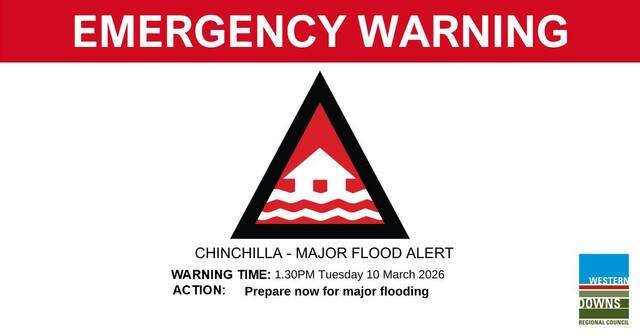
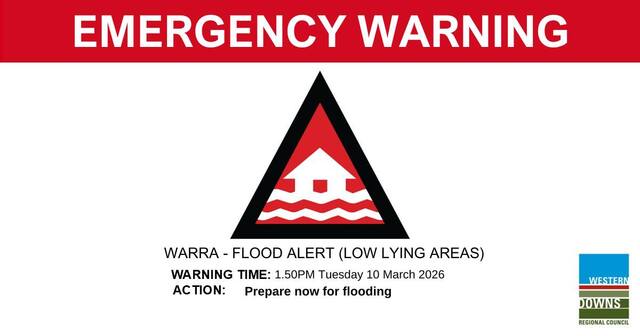
This is a FLOOD EMERGENCY WARNING message from the Western Downs Local Disaster Management Group.
Charley’s Creek in Chinchilla and Cooranga Creek in Warra are expected to exceed the major flood level of six metres this afternoon with further rises expected. Residents in low lying areas should PREPARE TO LEAVE. You should warn neighbours, secure your belongings and move to higher ground.
The Western Downs Regional Council recommends:
– Residents in low-lying areas should prepare now and not leave it until nightfall to action their household emergency plans.
– Low-lying residents should plan to stay with family or friends. Evacuations are voluntary at this stage, and no emergency evacuation centre has been established. This may change as we continue to monitor the rising flood levels.
– Major roads and highways will be closed.
– Take your mobile phone, charger, medicine, identification, cash, and keys with you.
– If you have children make sure they are with you or an adult you trust.
– Take enough clothes, food, water, medicine, baby items (like nappies, formula) and pet food for three days. Plan not to have a fridge or microwave.
– Ensure your pets are included in your emergency plan, remember to include identification information for them.
– Decide how you will get to your safe place.
– If you find it hard to move quickly, leave as soon as you can. If you do not drive, call your support service, a family member, or a friend to organise transport.
– If you come to a flooded road, turn around and go another way. Do not drive through floodwater. Do not walk or swim through flood water.
– If driving conditions are dangerous, safely pull over on higher ground away from trees, drains, low-lying areas, and floodwater. Find alternative travel routes if roads or underpasses are flooded.
– Help others if safe to do so.
If you find it hard to move quickly or have special or medical needs:
• Use your Person-Centred Emergency Plan (P-CEP) now if you have one.
• Make sure you have enough medicine for at least one week.
• If anyone in your house uses powered medical equipment, like a dialysis machine or ventilator, decide now where you will go in case you lose power.
• Call your support person or service to organise transport if you need to leave.
• Leaving early and during daylight hours is safer than waiting and travelling at night.
If you are a tourist, visitor, camper or caravanner:
• Campers and caravanners should start packing up now.
• If you do not need to be in the warning area, leave now. Check road conditions and plan your route before you leave.
• Be ready to move if the situation gets worse.
For life threatening emergencies phone 000. Stay up to date for the latest information from BoM.
For more information listen to local radio or visit disaster.wdrc.qld.gov.au.
For assistance with a life-threatening situation phone Triple Zero (000) immediately.
For assistance with non-life-threatening situations — such as help with a damaged roof or storm damage — phone SES on 132 500.
Keep up to date with the latest weather advice at Queensland Warnings Summary (bom.gov.au).